

With a 3 kW heater, the size fitted to our Spa Compact 4, Spa Sunset 5 and Spa Relax 6, every hour the heater runs cost between €0.33 and €1.01 on Spain’s regulated electricity tariff (PVPC) from November 2025 to October 2026, electricity tax and VAT included. Off-peak hours were the cheapest in 10 of those 12 months, and peak hours were the dearest in all of them.
What a month costs you depends on how many hours the heater has to run, and that changes with the season, the cover and how often the tub is used. Below are the real prices by month and time of day, the formula to work out your own figure, and what changes it on the Costa Blanca.
How much does one hour of hot tub heating cost in Spain?
An hour of a 3 kW heater uses 3 kWh. On the PVPC tariff in mainland Spain, that hour cost €0.57 to €1.01 at peak times, €0.37 to €0.71 at standard times and €0.33 to €0.68 off-peak, depending on the month. Only supplies with up to 10 kW of contracted power can be on the PVPC (Royal Decree 216/2014, art. 5.3).
The figures are monthly averages of the hourly PVPC price that Red Eléctrica publishes, grouped into the three periods of the 2.0TD tariff. To each one we added the electricity tax of 5.11269632% (Law 38/1992, art. 99) and 21% VAT (Law 37/1992, art. 90).
The exception is 22 March to 31 May 2026. Royal Decree-law 7/2026 (articles 40 and 42) cut the electricity tax to 0.5%, with a minimum of €1 per MWh for homes, and VAT to 10% for contracts of up to 10 kW. The cut was due to run until 30 June, but it stopped in June because the electricity consumer price index for April was 4.3% lower than a year earlier (INE). Royal Decree-law 18/2026 would have brought it back in August or September only if that index had risen more than 15% in June or July; it rose 6.0% and 8.4%, so it did not apply.
| Month | Peak (P1) | Standard (P2) | Off-peak (P3) |
|---|---|---|---|
| Nov 2025 | €0.78 | €0.51 | €0.41 |
| Dec 2025 | €0.85 | €0.58 | €0.44 |
| Jan 2026 | €0.84 | €0.55 | €0.41 |
| Feb 2026 | €0.74 | €0.42 | €0.33 |
| Mar 2026* | €0.79 | €0.47 | €0.40 |
| Apr 2026* | €0.59 | €0.37 | €0.34 |
| May 2026* | €0.57 | €0.37 | €0.35 |
| Jun 2026 | €0.68 | €0.44 | €0.43 |
| Jul 2026 | €0.81 | €0.56 | €0.54 |
| Aug 2026 | €0.81 | €0.56 | €0.60 |
| Sep 2026 | €0.90 | €0.62 | €0.65 |
| Oct 2026 | €1.01 | €0.71 | €0.68 |
If you are not on the PVPC but on a fixed-price contract with a supplier, use the price per kWh on your bill instead: the formula below works the same.
How do you work out your own monthly running cost?
Multiply the heater’s power by the hours it runs and by the price of each kWh. For a 3 kW heater on the PVPC, the formula is:
Cost (€) = 3 kW × hours of heating × price per kWh × 1.0511 × 1.21
The two last factors are the electricity tax and VAT. They were lower from 22 March to 31 May 2026, as explained above.
Each hour a day that the heater runs over a 30-day month adds 90 kWh. With the averages above, that came to €9.81 a month in off-peak hours in February 2026 and €30.18 a month in peak hours in October 2026. Two hours a day doubles it.
The first heat after filling is a separate cost. Warming 1 kg of water by 1 °C takes 1.162 Wh, which comes from the heat capacity of liquid water in the NIST Chemistry WebBook (about 4.18 kJ per kg and °C at 25 °C), and a litre of water weighs close to 1 kg. So, approximately:
kWh to heat the water = litres × 1.162 × degrees of rise ÷ 1,000
Take the NatuSpa M 6/67, a 200 × 200 cm, six-person tub that holds 1,197 litres according to the 2026 catalogue of its supplier, Baeza. Raising its water by 20 °C takes 1,197 × 1.162 × 20 ÷ 1,000 = 27.8 kWh. Baeza’s catalogue gives the tub’s total power, not the heater’s, so assume a 3 kW heater, like the one in our Compact 4, Sunset 5 and Relax 6: it needs at least 9.3 hours for that, plus whatever heat escapes while it works. In off-peak hours that first heat cost about €3.03 in February 2026 and €6.29 in October 2026.
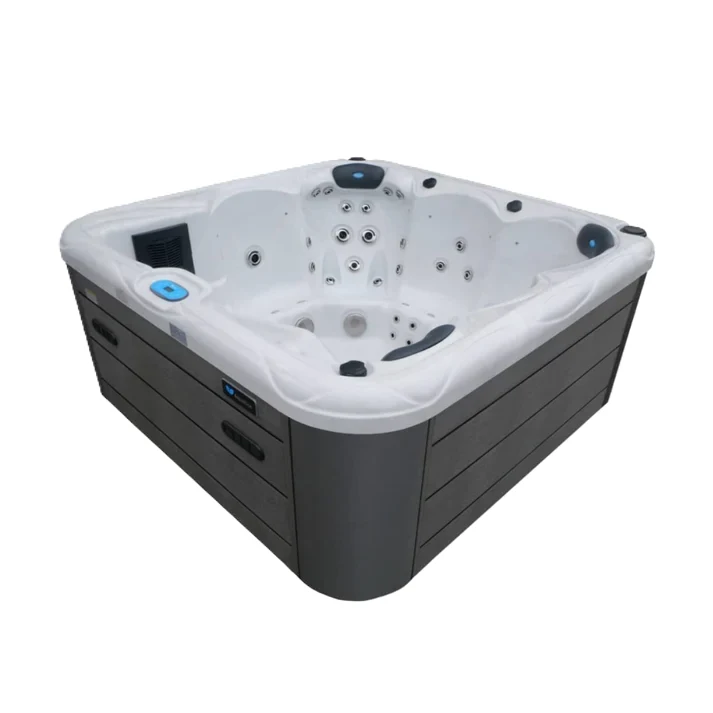
Why does a hot tub cost more to run in winter on the Costa Blanca?
Because the gap between the water and the air is bigger, and the heat that escapes through the shell, the cover and the surface grows with that gap. The heater then has to run more hours to hold the temperature you set.
In Alicante, the average temperature is 11.7 °C in January and 26.0 °C in August, according to the AEMET climate normals for the Alicante station (1981-2010). With the water at 38 °C, the gap is 26.3 °C in January and 12.0 °C in August: more than twice as wide in winter.
Electricity prices do not follow the same calendar. In this period the dearest off-peak months were August to October 2026, which include the warmest month of the year, so the bill does not simply track the season.
When is electricity cheapest for a hot tub in Spain?
Off-peak (P3, “valle”): from midnight to 8 am on weekdays, and all day on Saturdays, Sundays, 6 January and national holidays. That is how the 2.0TD tariff, for supplies with up to 15 kW of contracted power, splits the hours in CNMC Circular 3/2020, article 7.3.
- Peak (P1, “punta”): 10 am to 2 pm and 6 pm to 10 pm, Monday to Friday.
- Standard (P2, “llano”): 8 am to 10 am, 2 pm to 6 pm and 10 pm to midnight, Monday to Friday.
- Off-peak (P3, “valle”): midnight to 8 am on weekdays, and every hour of weekends and national holidays.
Off-peak was not always the cheapest period, though. In August and September 2026 the average off-peak hour cost more than the average standard hour (€0.60 against €0.56 in August), and in May and June the gap was about a cent. Peak was the most expensive period in every month.
What can you do to keep the running cost down?
- Keep the cover on whenever nobody is in the tub. Our three models come with a made-to-measure cover in the price.
- Heat in off-peak hours if your control panel lets you set when the heating and filtration cycles run. On the PVPC, the same hour of heating cost up to €0.33 less off-peak than at peak in October 2026 (€0.68 against €1.01).
- Check what it really uses. Datadis, the platform created by Spain’s electricity distributors, shows your consumption by the hour, so you can compare the weeks before and after the tub goes in.
- Ask about your contracted power before installing. The power charge is a fixed daily amount that is not included in the per-hour figures above, and the electrician who connects the tub is the one who should size it.
What do the data sheets of our hot tubs say about energy?
The data sheets of the Spa Compact 4, Spa Sunset 5 and Spa Relax 6 give a 3 kW heater, an independent circulation pump, a 3 HP massage pump, Balboa controls and an ozonator. They do not give the water volume or a standby consumption figure, so we do not publish a monthly cost for them: ask us and we will tell you what we know for the model you are looking at.
You can compare all the models and their prices in our hot tubs section. The Compact 4 is the four-person model at 200 × 155 cm; the Sunset 5 and the Relax 6 measure 195 × 195 cm.
Want help choosing a hot tub that suits your bill?
We sell and install hot tubs from our base in Los Montesinos (Alicante), and we work in Torrevieja, Orihuela Costa, Pilar de la Horadada, Guardamar del Segura, Rojales, Almoradí and Alicante. See all our hot tubs for sale, read about our installation and maintenance services, or book a free consultation and we can visit you at home.
Sources and method
- Prices: hourly PVPC price for mainland Spain, Red Eléctrica (REData API), 1 November 2025 to 31 October 2026, downloaded on 17 November 2026. Each hour was assigned to its 2.0TD period (weekends, 6 January and fixed-date national holidays as off-peak) and averaged by month.
- Taxes: electricity tax 5.11269632% (Law 38/1992, art. 99) and VAT 21% (Law 37/1992, art. 90); from 22 March to 31 May 2026, 0.5% (minimum €1/MWh) and 10% (Royal Decree-law 7/2026, arts. 40 and 42, in force from 22 March 2026; stopped in June under its own condition, with INE’s electricity CPI for April at -4.3%). Royal Decree-law 18/2026 (arts. 10-13) did not apply in August or September (INE: +6.0% in June, +8.4% in July). BOE consolidated texts and INE table 76128 checked on 17 November 2026. The fixed power charge and meter rental are not included.
- Climate: AEMET climate normals 1981-2010, Alicante station 8025.
- Products: data sheets of the Spa Compact 4, Sunset 5 and Relax 6, and Baeza catalogue 2026 for the NatuSpa M 6/67.
Prices checked in November 2026. We review this article every six months.
Research and writing: Elevate Web.
